
The Ultimate Showdown of LED Face Masks
Updated: Sep 3
In a market flooded with at-home facial devices, is there one which stands out and really delivers remarkable results in the comfort of your own home? I have collated the top searched devices to find the Best LED Face Mask.
At-home LED Face lights began appearing in early 2010s with advancements in LED technology making them more accessible. They have been used in dermatology and cosmetic procedures since the 1990s for their skin healing and inflammation reducing abilities.
These days, you are more likely to see influencers on social media wearing bright red illuminated face masks as part of their weekly beauty regimes.
What is LED Phototherapy?
LED Phototherapy works by penetrating light into the skin. This light is absorbed by our cells, stimulating different responses.
Red light generally stimulates ATP, the energy within our cells, increasing replication and rejuvenation - perfect for anti-aging.
Near Infrared the deepest penetrating light provides calming and anti-inflammatory benefits - your light for rosacea, eczema, psoriasis.
Blue light fights against the p-acnes bacteria on the skin which is a contributor towards acne and breakouts.
If you want to delve deeper into what these lights do, head on over to my other post "Harness the power of Light".
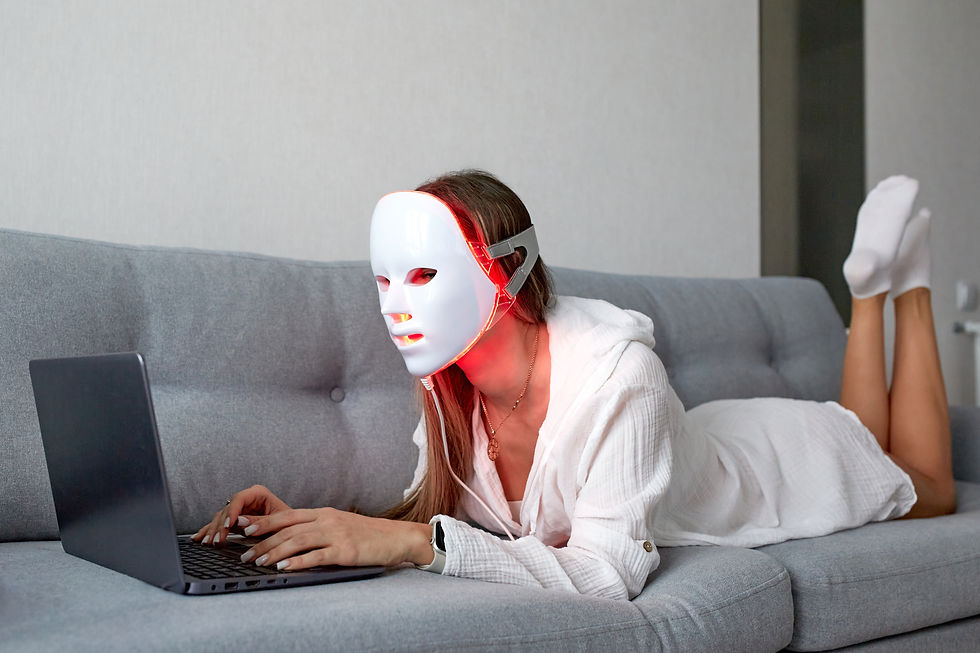
The question still arises: "Which face mask should I buy?" Don't worry, I have researched and found the all important details to consider when purchasing your LED face mask.
What is the difference between masks?
It is important to find a mask which is comfortable. Consider whether you want to be able to continue with your daily tasks whilst wearing it or incorporate it into your 10/20 minutes of daily meditation as some are mobile and others need to be plugged in. The one pictured above is rigid and probably a little heavier than the silicone moulding ones*.
Depending on what you would like to treat, some masks have different light modes, the ones I have reviewed below have two or three, Red, Near Infrared and Blue. Red and Near Infrared are my favourites as Blue needs more caution, it is not always suitable for anyone with pigmentation issues as there is some evidence that blue light could stimulate your melanocyte cells (1).
Most of the masks use the same penetrating level of light, with Red light at 633nm, Near Infrared at 830nm and Blue at 415nm so that would not be a deciding factor. The most important part is clinical evidence for the device.
Anyone can manufacture a mask with LED's but the defining factor of whether results can be achieved is determined by many elements; LED quality, number of wavelengths within the LED, positioning of the LED, distance of light from the skin and whether all of these elements work in harmony.
What actually makes one LED device different from another?
LED position - Where are the lights? This affects how evenly the light reaches your skin. The further the LED's are from your skin, the more light spreads out and the less concentrated it becomes. A well designed device aims to deliver relatively even light across the whole treatment area and the power of the LEDs will be devised to compliment the distance.
It's not just about how many lights there are, it's about where those lights are positioned in relation to your skin.
How powerful is the light?
Irradiance levels measure the intensity of the light reaching your skin and is measured in M=mW/cm2 (milliwatts per square centimetre)
Think of it like a shower:
Low irradiance = a gentle trickle
Higher irradiance = a strong flow
Higher isn't automatically better. There is an optimal range for photobiomodulation, and increasing the intensity doesn't necessarily increase the benefit.
The right amount of light intensity matters, not simply the highest number.
How much light does your skin actually receive?
Joules is the energy dose delivered during treatment, it is measured in J/cm2 (joules per square centimetre) and this is where irradiance and treatment time come together.
So you can have a lower intensity and longer treatment or a higher intensity and shorter treatment and potentially deliver the same total energy dose.
Joules tell you how much light energy your skin receives during the treatment time.
How many lights are there?
This is probably the most misunderstood specification and I'm not ashamed to say it got me to!
Having 500 LEDs doesn't automatically make a device better than one with 100 LEDs. What matters more is - where the LEDs are, what wavelength they produce, how much light reaches your skin and the dose delivered.
One LED can also contain multiple light emitting chips, so manufacturers may count these differently. So don't judge an LED device by the number of LED's alone.
The Ultimate Showdown of LED Face Masks
When choosing an LED device, don't just look at how many LED's it has or how many colours it produces. What really matters is the combination of wavelength, light intensity, treatment time and the total dose delivered to your skin - plus how evenly that light reaches the treatment area.
If I were looking to purchase a device in a market which is saturated, I would always choose a manufacturer which has high levels of expertise and a speciality within the industry; phototherapy is their business and they can provide all of the information above with clinical trials to back up the data.
Below is the latest list of LED Face Masks on the market, I have found as much of the information available as advertised to the consumer so you can make your own, newly informed selection.
CURRENTBODY SERIES 2 LED MASK
Lights: Red 633nm, Near Infrared 830nm & Deep Near Infrared 1072nm (they also do a separate Blue light mask)
Number of LED's: 236
Treatment time: 10 minutes
Hands Free device: Yes
Form: Flexible
Price: £399.99
DR DENNIS GROSS SPECTRALITE PRO
Lights: Red 630nm, Near Infrared 880nm, Amber 605nm, Blue 415nm
Number of LED's: 162
Treatment time: 3 minutes
Hands Free device: Yes
Form: Rigid
Price: £465
DERMALUX FACE MASK
Lights: Red 633nm, Near-Infrared 830nm, Deep Near-Infrared 1072nm
Number of LED's: 144
Irradiance Intensity: 36 mW/cm2
Joules: 21.6 J/cm2
Treatment time: 10 minutes
Hands Free device: Yes
Form: Rigid off the face by 10mm
Price: £399 launch price - £499 afterwards
DERMALUX FLEX
Lights: Red 633nm, Blue 415nm, Near Infrared 830nm (can be used separately or in unison)
Number of LED's: 360
Treatment time: 20 minutes
Hands Free device: No
Form: Overhead
Price: £1,999
EXPRESS DEESSE PRO
Lights: Red 630nm, Near Infrared 830nm
Number of LED's: 66 combined
Treatment time: 10 minutes
Hands Free device: Yes
Form: Flexible
Price: £299
DECOLITE/FACELITE (sister company to Omnilux)
Lights: Red 633nm, Near Infrared 830nm
Number of LED's:132
Treatment time:10 minutes
Hands Free device: Yes
Form: Flexible
Price:£299
FACELITE PRO
Lights: Red 610nm, 630nm, 660nm. Near-infrared 850nm and 1070nm
Number of LED's: TBC
Irradiance Intensity: 52.1mW/cm2
Joules: TBC
Treatment time: 10 minutes
Hands Free Device: TBC
Form: Flexible
Price: £395
SHARK CRYOGLOW
Lights: Red 630nm, Near Infrared 830nm, Blue 415nm (under-eye clip on chill pads added extra)
Number of LED's: 480
Treatment time: 4, 6 or 8 minutes
Hands Free device: Yes
Form: Rigid
Price: from £299.99
Which is the Best LED Face Mask: A Glowing Review
For me, there are two masks which really stand out, not surprisingly they are two of the leading manufacturers in LED technology.
The Dermalux Face Mask and The Facelight Pro tick every box for me. They are well priced, showcasing the latest innovations in LED phototherapy with the clinical studies to back up their claims.
References
*I have not personally tried all of these masks but have a business connection/paid partnership with Dermalux and Facelight. The opinions expressed in this blog are my own and the information provided is what has been collated from each individuals product page.


